
How Much Do Dental Implants Cost? What Affects the Price
Reviewed by Dr. Lena Khan, DDS
November 19, 2026
Most people asking how much do dental implants cost are not hunting for a bargain. They want to know whether the number on their treatment plan is normal, and what could push it higher. An implant is priced in parts rather than as one flat fee, and the parts you need depend on your bone, your gums and how long the tooth has been missing. Here is what sits inside the total, and where the real differences between two quotes come from.
Key Takeaways
On this page
How Much Do Dental Implants Cost on Average?
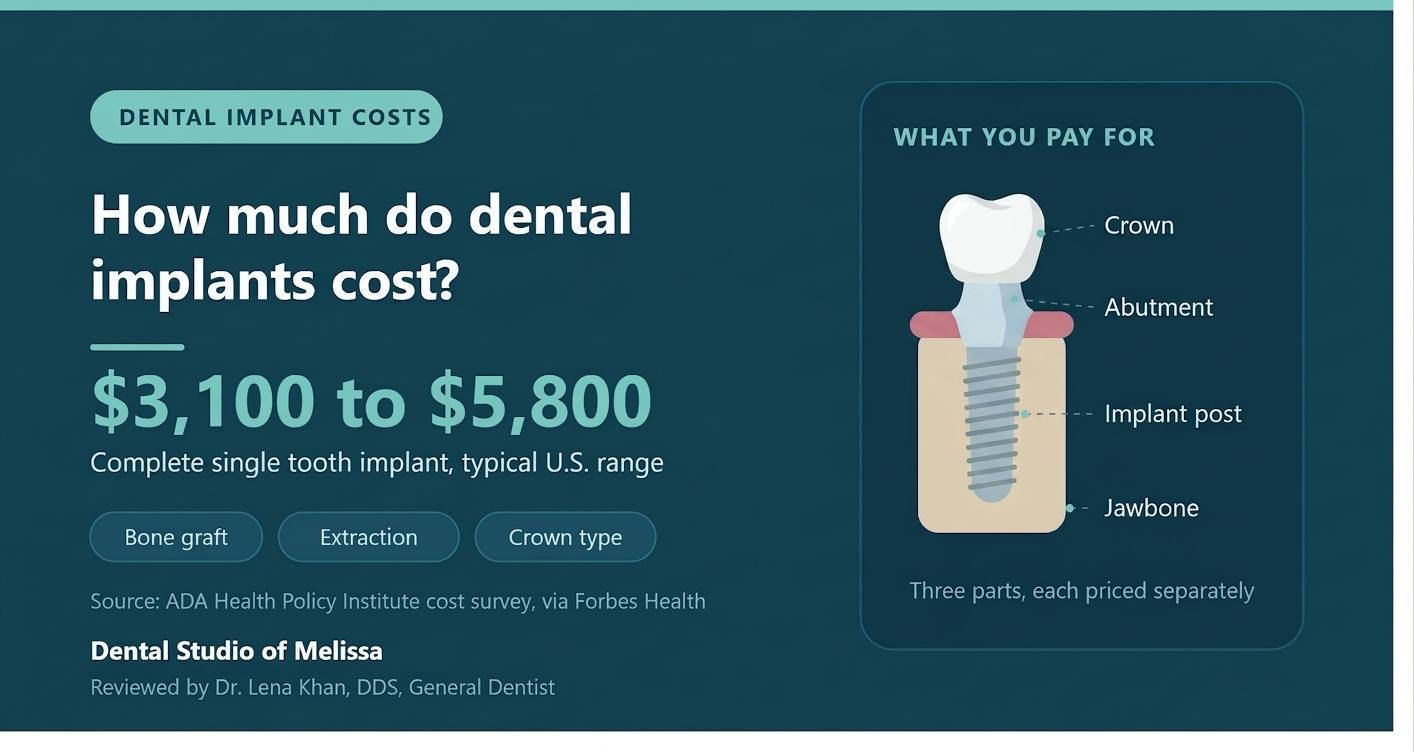
A complete single tooth implant costs roughly $3,100 to $5,800 in the United States, according to Forbes Health citing the American Dental Association's Health Policy Institute cost survey. That figure covers the implant, the abutment, the crown and other necessary steps. Replacing several teeth at once changes the math, because a few implants can carry more than a few teeth.
| Treatment | Typical national range | What that covers |
|---|---|---|
| Single tooth implant | $3,100 to $5,800 | Post, abutment, crown and other needed steps |
| Implant bridge, 3 or 4 teeth | $6,000 to $10,000 | Two implants carrying several teeth in a row |
| Implant supported full set | $24,000 to $50,000 | Upper and lower arches on four to six implants each |
| Full mouth, tooth by tooth | $60,000 to $90,000 | Individual implants throughout the mouth |
| 3D imaging, if billed separately | $350 to $515 | The scan used to plan the implant position |
Ranges reported by Forbes Health. These are national figures for planning, not our fees. We quote your case in writing after an exam.
What Are You Actually Paying For in a Dental Implant?
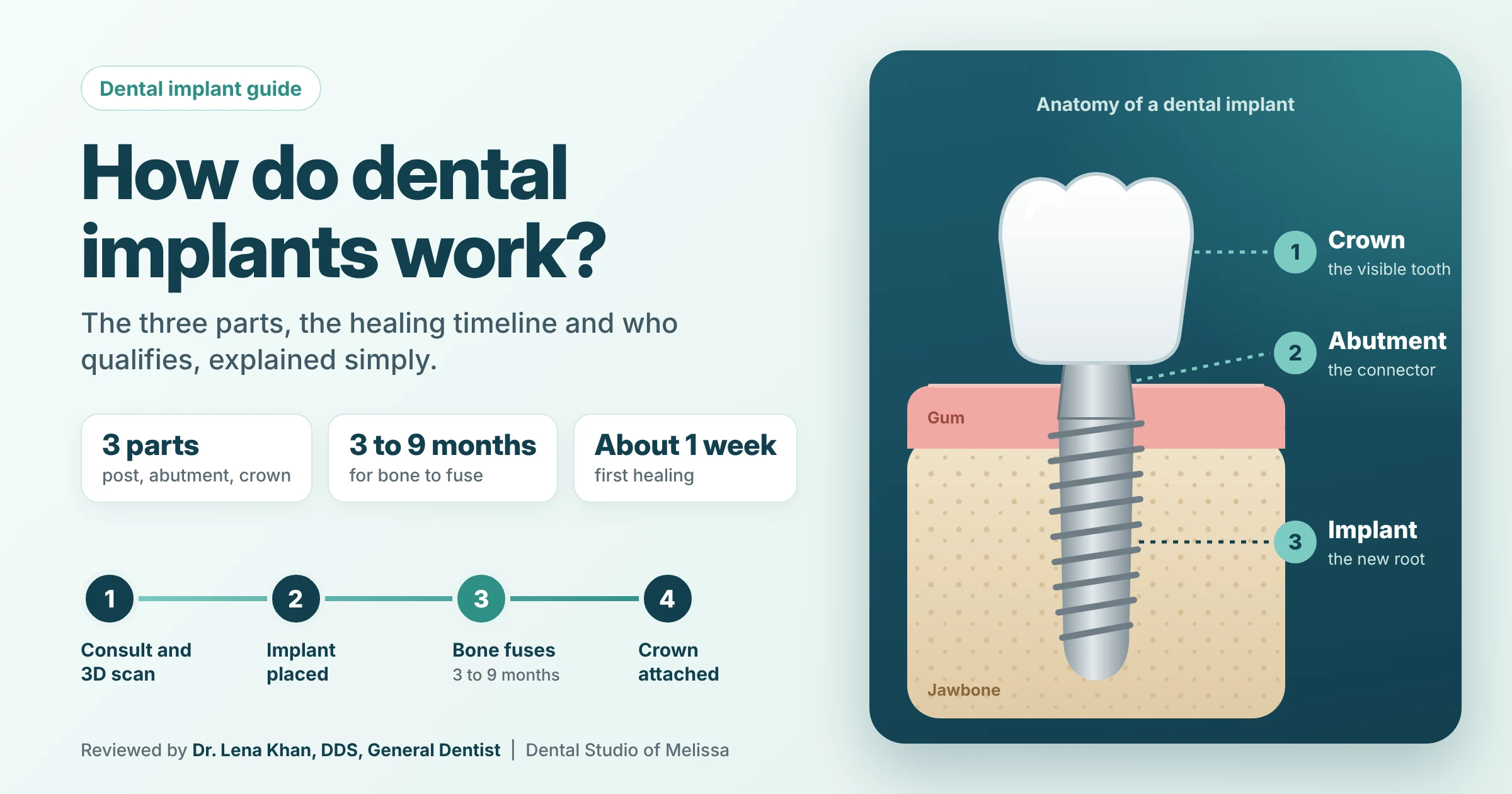
You are paying for three separate pieces plus the work around them: the titanium post that replaces the root, the abutment that connects to it, and the crown you see and chew with. Each piece is priced on its own, which is why two quotes for the same tooth can look thousands apart.
Where the money goes
The visible tooth, shaded to match. Material choice moves this line.
The connector between post and crown. Custom versions cost more than stock ones.
The artificial root placed in the jawbone, plus the surgical visit itself.
Extraction, bone graft, sinus lift, 3D scan, sedation. Each adds a fee and healing time.
Abutment: the small connector that screws into the implant post and holds your crown. It sits just above the gumline and is usually billed as its own item.
In our chair, right after people ask whether it will hurt, they ask what it costs. Our page on dental implant treatment walks through what a single tooth case involves, and the pillar guide covers how dental implants work step by step.
What Affects How Much Dental Implants Cost?
Six things move an implant quote more than anything else: how much healthy bone you have, how many teeth you are replacing, whether the tooth still needs removing, the material of the final crown, the imaging used to plan it, and whether you choose sedation. Bone is usually the biggest single swing.
How much each factor moves the total
Bone volume and grafting
A graft or sinus lift adds a surgical step and months of healing.
Number of teeth replaced
Two implants can carry three or four teeth, which lowers the cost per tooth.
Extraction and timing
Removing the tooth is its own fee, and waiting afterward can add a graft later.
Crown material and lab work
Front teeth often need more shading work than back teeth.
Imaging and planning
Forbes Health reports $350 to $515 when a 3D scan is billed on its own.
Sedation
Optional, and worth it for some anxious patients.

Why the scan, not the consultation, settles the price
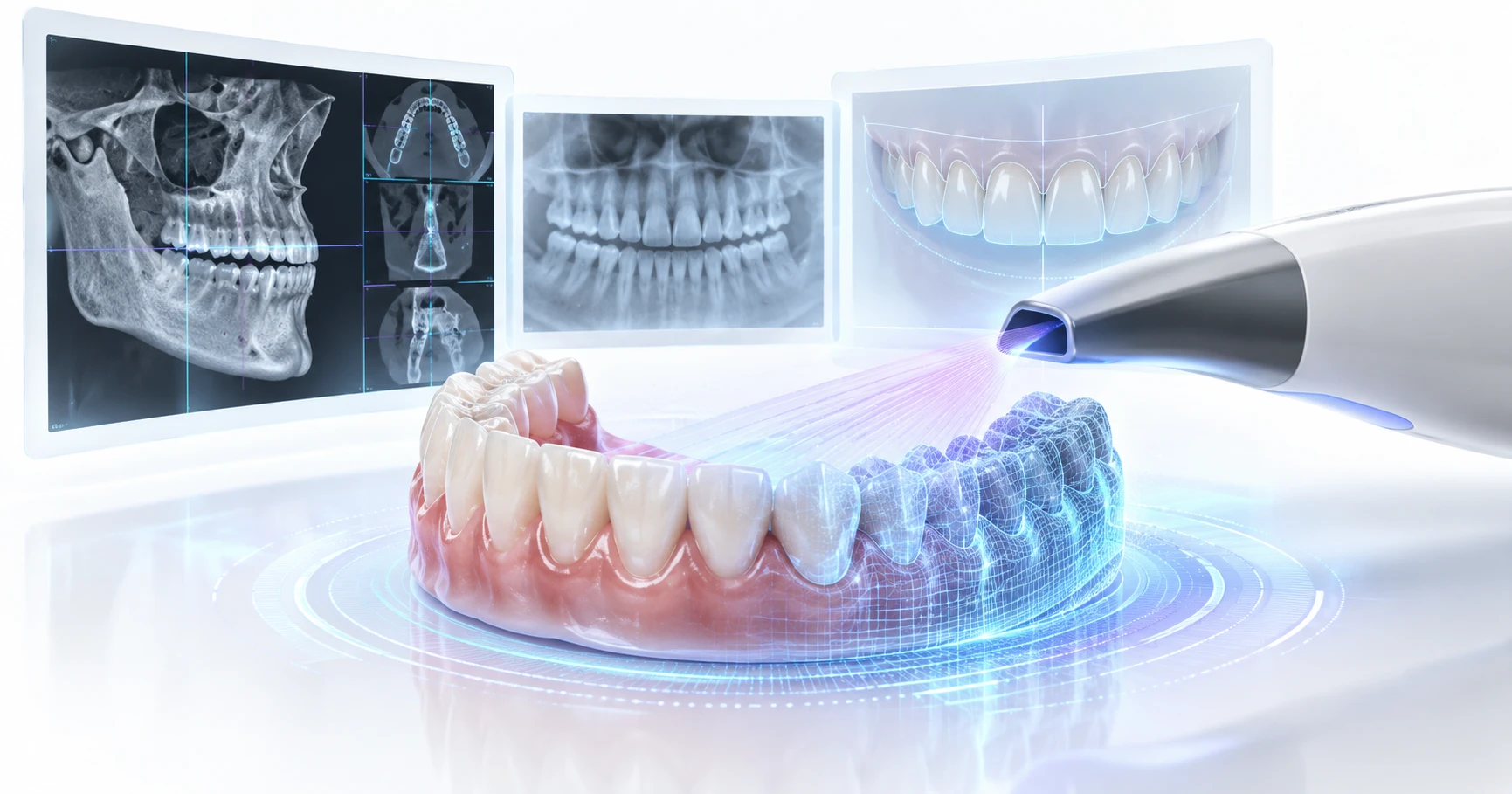
A quick look in the mirror cannot show bone width, bone height or how close the site sits to a nerve or sinus. A CBCT scan can, and that image is what decides whether a bone graft before implants belongs in your plan. Dr. Lena Khan, DDS, General Dentist, founder of our practice, earned her Doctor of Dental Surgery at the University at Buffalo School of Dental Medicine, completed Advanced Education in General Dentistry in 2011 and has advanced training in dental implants.
A pattern we see at implant consultations: someone brings two plans that look thousands apart, and the gap turns out to be an abutment on one and not the other, or a graft counted in one and left for later. That is the honest contrarian part of implant pricing. The cheaper number is often the less complete number, not the better deal.
Want a number you can actually plan around?
We check your benefits first and explain insurance and payment options, including 0% APR financing for qualified patients through Cherry, CareCredit and Sunbit.
Call or text (469) 505-3055Does Dental Insurance Cover Implants?
Many plans now pay something toward implants, but a yearly cap limits how much. Forbes Health reports that patients with coverage can typically expect about $1,500 per implant per year, and that work spanning two calendar years may draw on two years of benefits. Coverage still varies plan by plan.
The cap matters more than the percentage. The American Dental Association reports figures from the National Association of Dental Plans showing that 32.8% of in network annual maximums fall between $1,000 and $1,500, while 48.2% fall between $1,500 and $2,500. The same article describes the familiar plan design: 100% for preventive care, 80% for basic work and 50% for major work.
100%
Preventive care, the usual tier
80%
Basic treatment, the usual tier
50%
Major treatment, where implants often sit
Cap
Payment stops at the annual maximum
We accept most PPO dental plans and will verify your benefits before treatment. Plans we commonly see include Delta Dental, Cigna, Aetna, MetLife, Guardian, UnitedHealthcare, Humana, Blue Cross Blue Shield, Principal and Ameritas. Original Medicare does not cover routine dental care, though many Medicare Advantage plans include PPO dental benefits we can accept. Texas Medicaid and CHIP dental plans are managed care plans, so call before booking so we can check your coverage.
Flexible spending accounts, health reimbursement accounts and health savings accounts can all be used toward implant costs, as Forbes Health notes. Timing the stages across two plan years is a budgeting move, not a clinical one, so it only works when your treatment schedule allows it.
Implant, Bridge or Denture: Which One Costs Less?
A bridge or a partial denture almost always costs less upfront than an implant. The comparison changes over time, because replacement cycles differ and a bridge requires reshaping the healthy teeth on either side. Cleveland Clinic reports typical lifespans that help put the numbers in context.
| Question | Implant | Bridge | Removable denture |
|---|---|---|---|
| Upfront cost | Highest of the three | Middle | Lowest |
| Typical lifespan | Implant can last a lifetime; crown often about 15 years | Often about 15 years | At least 7 years |
| Neighboring teeth | Left untouched | Shaped and crowned | Clasps may rest on them |
| Surgery | Yes, under local numbing | No | No, unless teeth are removed |
The honest part: an implant is not the right answer for everyone. When the teeth on either side of a gap already need crowns, a bridge does double duty and often costs less overall. When several teeth are missing, full arch dental implants can cost less per tooth than replacing each one separately. And if a scan shows very limited bone near a nerve or sinus, or your medical history adds real surgical risk, we refer you to an oral surgeon or periodontist rather than stretching a case to fit our office.
How Can You Lower the Cost Without Cutting Corners?
You can lower an implant bill in five practical ways: act early, compare plans line by line, use your benefits across two plan years, ask about phasing the work, and finance the remainder. None of these involves skipping a step that holds the implant in place.
- Do not wait. Bone narrows after a tooth is lost, and a graft added later costs more than placing an implant while the site is still healthy.
- Compare what is included. Ask every office whether the quote contains the post, the abutment, the crown, the scan and any graft.
- Check your annual maximum first. Knowing your cap tells you what the plan can realistically pay this year.
- Ask about phasing. Placement and the final crown naturally fall months apart, which sometimes lines up with a new plan year.
- Use financing deliberately. Cherry, CareCredit and Sunbit offer 0% APR options for qualified patients, which spreads cost without adding interest.
Five questions to ask at any implant consultation
- Does this quote include the abutment and the final crown?
- Does my scan show enough bone, or is a graft likely?
- What happens to the price if a graft turns out to be needed?
- Who places the implant and who restores it?
- What will my plan pay this year, and what is left for me?
Get a Written Estimate Before You Decide
The only reliable way to learn how much dental implants cost in your own mouth is an exam with a 3D scan. In one visit we check bone, gums and bite, verify your PPO benefits, explain every option including when a bridge or denture fits better, and hand you a written plan with costs before anything starts. After enough consultations, you learn that people regret rushed decisions far more than they regret asking for the number in writing.
Book an implant consultation with a 3D CBCT scan
Dr. Lena Khan, DDS, General Dentist, reviews your scan with you at Dental Studio of Melissa and answers every cost question before you commit. Book online, or call or text us. Select Saturday appointments are available on set dates, so call to confirm.
Frequently Asked Questions
How much does a single tooth dental implant cost?
Forbes Health, citing the American Dental Association's Health Policy Institute cost survey, puts a complete single tooth implant at $3,100 to $5,800. That range covers the implant post, the abutment, the crown and other necessary steps. Your own figure depends on bone condition, whether an extraction or graft is needed, and the crown material.
Why do dental implant quotes vary so much?
Implants are billed in parts, so two quotes can describe different work. One may include the abutment, crown and 3D scan while another lists only the surgical placement. Ask each office to confirm in writing which pieces are included and what happens to the price if a bone graft turns out to be necessary.
Does dental insurance pay for implants?
Many PPO plans now pay something, usually limited by an annual maximum. The American Dental Association reports National Association of Dental Plans figures showing 32.8% of in network annual maximums fall between $1,000 and $1,500, and 48.2% between $1,500 and $2,500. We verify your benefits before treatment so the number is not a surprise.
Is a cheaper implant a worse implant?
Not always, but a lower total often reflects fewer included items rather than a discount on the same work. Compare the components, the imaging and whether grafting is accounted for. A plan that leaves out the crown or a needed graft is an incomplete estimate, not a saving.
Have a question about your own tooth? Call or text us at (469) 505-3055 and we will help you plan the next step.
This article is general information, not a diagnosis. For advice about your own teeth, please see a dentist.
Still weighing the cost of an implant?
Reviewed by Dr. Lena Khan, DDS — General Dentist. Bring your quote, your scan or just your questions. We check bone, gums and benefits, then put the numbers in writing.
Need urgent dental care now?
Call Dental Studio of Melissa and we will help right away.