
Dental Implants Explained: How They Work, Who Qualifies and What to Expect
Reviewed by Dr. Lena Khan, DDS
November 10, 2026
Reviewed by Dr. Lena Khan, DDS — General Dentist, Dental Studio of Melissa
Losing a tooth raises a fast, practical worry: what goes back in that space, and will it ever feel like a real tooth again? If you've been asking how do dental implants work, the short version is that a small titanium post replaces the root, your jawbone grows around it, and a custom crown attaches on top. The details matter, because bone, gum health and timing decide whether an implant is the right fit for you. This guide covers each step, who qualifies, what recovery feels like and how implants compare with bridges and dentures.

Key Takeaways
An implant replaces the tooth root, which helps protect the jawbone in that spot.
Bone fusion usually takes 3 to 9 months, while the first round of gum healing takes about a week.
Healthy gums, enough bone and controlled health conditions matter more than age; the minimum is typically 18.
Smoking, unmanaged diabetes and untreated gum disease raise the risk, so we address them first.
With good care the implant can last a lifetime, while the crown on top often lasts around 15 years.
In this guide
- What is a dental implant?
- How do dental implants work with your jawbone?
- How do dental implants work, step by step?
- Who qualifies for dental implants?
- Implants vs bridges vs dentures
- What does recovery feel like?
- What affects the cost?
- How long do dental implants last?
- Common mistakes to avoid
- Find out if an implant fits you
- Frequently asked questions
What Is a Dental Implant?
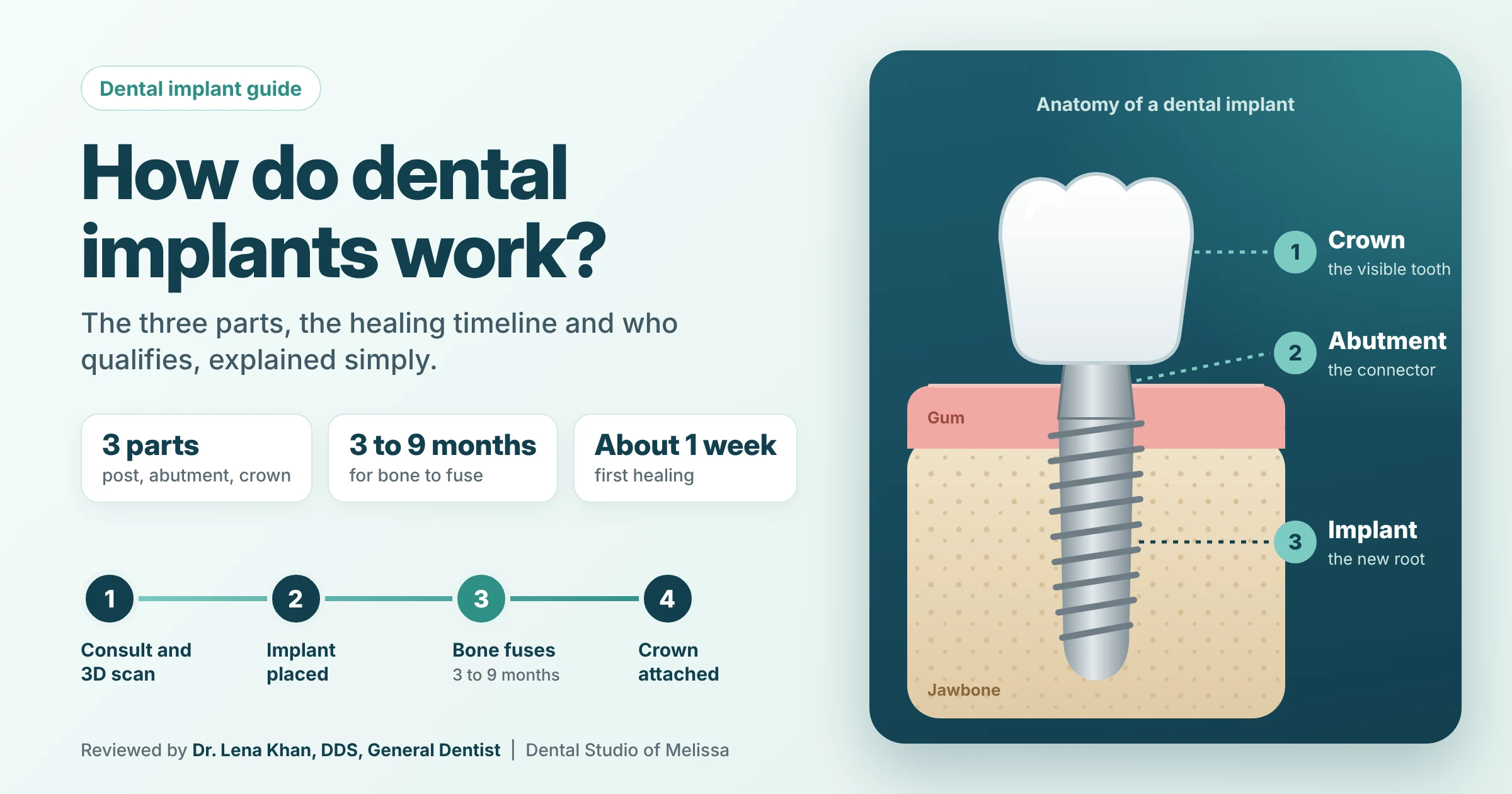
A dental implant is a small, threaded post, usually titanium and sometimes ceramic, that takes the place of a missing tooth root. Once it heals into the jawbone, it supports a crown, a bridge or a denture. Cleveland Clinic describes three main parts: the post, a connector called an abutment, and the visible restoration.
The three parts of a dental implant
The visible tooth, custom shaded to match your smile. It can also be a bridge or a denture.
A small connector that screws into the post and rises just above the gumline.
The artificial root that sits in the jawbone and fuses with it over several months.
Implants come in three main setups. A single implant replaces one tooth. Two or more implants can hold an implant bridge that replaces three or more teeth. A full arch usually uses four to six implants to hold a complete set of upper or lower teeth, which is what All-on-X full arch implants are built on.
If you're missing a single tooth, our page on dental implant treatment explains how we restore one gap without touching the teeth beside it.
How Do Dental Implants Work With Your Jawbone?
Dental implants work because living bone grows tightly against the implant surface and locks it in place. That bond lets an implant handle chewing forces much like a natural root. According to Cleveland Clinic’s dental implant overview, the fusion takes about three to nine months, depending on how quickly your body heals.
Definition
Osseointegration: the process of jawbone growing onto and around an implant until the two act as one solid unit. It’s the heart of how dental implants work, and the reason an implant feels stable instead of loose.
Bone needs work to stay healthy. A tooth root passes chewing pressure into the jaw, and that pressure keeps the bone around it active. When a tooth is lost, Cleveland Clinic notes the jawbone in that area can shrink, which over time leads to the sunken look some people notice after losing several teeth.
A pattern we see at checkups: someone lost a back tooth years ago, never replaced it, and the teeth beside the gap have slowly tipped into the space while the opposite tooth has drifted toward it. By then, the space and the bone may both need attention first.
An implant fuses directly to bone, so it can’t decay, yet the gum and bone around it can still get inflamed. Daily care matters as much as the surgery.
How Do Dental Implants Work, Step by Step?
Most implant treatment follows six stages: a consultation with a 3D scan, any extraction or bone grafting, placement of the implant, a healing period of about 3 to 9 months, attachment of the abutment and final crown, and regular maintenance visits. Many people need only some of these steps.
The dental implant process at a glance
1Consultation and 3D scan
Exam, health history and a CBCT scan.
1 visit2Extraction or graft
Only if needed.
Varies3Implant placement
The post is placed under local numbing.
1 visit4Healing
Bone fuses to the implant.
3 to 9 months5Abutment and crown
Connector and final tooth attached.
About 1 hour6Maintenance
Cleanings and checkups.
OngoingWhat happens on the day the implant is placed?
Placement is usually a single visit. Based on the steps Cleveland Clinic outlines, the appointment typically looks like this:
- The area is numbed; sedation is available if you choose it.
- A small opening is made in the gum.
- The bone is shaped to the exact size of the implant.
- The implant is placed into the bone.
- The gum is closed with stitches.
A front tooth usually gets a temporary replacement so there’s no visible gap. A back tooth may not need one.
Do you need a bone graft first?
Some people do, and the scan answers that question, not a quick look in the mirror. If the bone is too thin or too short to hold a post, a bone graft before implants rebuilds the area, and the implant follows once the graft has healed.
Definition
CBCT scan: a low radiation 3D x ray that shows bone height, width and density, plus nearby nerves and sinuses, so an implant can be planned precisely.
When Dr. Khan reviews a CBCT scan before placing an implant, the first things she checks are the height and width of the bone and how close the site sits to the sinus or the nerve in the lower jaw. Dr. Lena Khan, DDS, General Dentist, earned her Doctor of Dental Surgery at the University at Buffalo and has advanced training in dental implants, and she places and restores implants in our office. Here’s how our 3D scanning makes visits more precise.
Not sure if you have enough bone?
A consultation with a 3D CBCT scan answers that in one visit, and you’ll leave knowing whether an implant, a graft or another option makes sense.
Call or text (469) 505-3055Who Qualifies for Dental Implants?
Most adults with healthy gums, enough jawbone and well controlled health conditions can be considered for an implant. Cleveland Clinic notes the minimum age is typically 18, once jaw growth is finished, and there’s no upper age limit. A commitment to daily cleaning and regular checkups matters just as much.
Good signs for an implant
- ✓ Missing one or more teeth, or a tooth that can’t be saved
- ✓ Healthy gums, or gum disease that has been treated
- ✓ Enough bone, or willingness to have a graft
- ✓ Finished jaw growth, typically age 18 or older
- ✓ Ready to brush, floss and keep regular visits
Needs a plan first
- ! Active or untreated gum disease
- ! Unmanaged diabetes
- ! Smoking or vaping, which can disrupt healing
- ! Severe bone loss in the jaw
- ! Some bone disorders, autoimmune conditions or medications
None of the items in the second column is an automatic no. Cleveland Clinic lists them as conditions that can make it harder for an implant to anchor or heal, so we plan around them: gum disease gets treated first, diabetes is brought under control with your physician, and smokers stop before placement.
When an implant isn’t the right call yet
Here’s the honest part. Sometimes the right answer is to wait, and sometimes it’s a different treatment altogether. If your scan shows very limited bone close to the sinus or a nerve, or your medical history adds real surgical risk, we’ll refer you to an oral surgeon or periodontist, the specialists who handle the most complex implant and grafting cases. If a bridge or partial denture fits your health and budget better, we’ll say so.
Dental Implants vs Bridges vs Dentures: Which Option Fits?
An implant replaces a tooth without touching its neighbors, a bridge anchors a false tooth to crowned teeth on either side, and a denture rests on the gums and comes out for cleaning. Each option suits different health situations, budgets and timelines, so the right choice depends on your mouth, not on what’s popular.
| Feature | Dental implant | Bridge | Removable denture |
|---|---|---|---|
| Neighboring teeth | Left untouched | Shaved and crowned for support | Clasps may rest on them (partials) |
| Surgery needed | Yes, under local numbing | No | No |
| Bone healing wait | Several months | None | None, unless teeth are removed |
| Jawbone in the gap | Helps preserve it | Not stimulated | Not stimulated |
| Cleaning | Brush and floss like a tooth | Floss under the false tooth | Removed and cleaned daily |
| Typical lifespan | Implant can last a lifetime; crown often around 15 years | Often around 15 years | At least 7 years |
Lifespans are typical figures reported by Cleveland Clinic and vary with care, bite forces and gum health.
A bridge can be the sensible choice when the teeth on either side of the gap already have large fillings or need crowns anyway, because crowning them does double duty. Our page on a bridge for a missing tooth walks through that option.
When several teeth are missing, or surgery isn’t right for you, dentures and partials restore chewing and appearance without an operation. Some people later add implants that the denture snaps onto.
What Does Recovery Feel Like After an Implant?
Most people have soreness and some swelling for a few days after implant placement, and Cleveland Clinic says patients usually feel like themselves within about a week. The deeper bone healing then continues quietly for months. You won’t feel the implant fusing, but you’ll eat softer foods and clean carefully around the site for a while.
Healing timeline
Gum healing, mild soreness and swelling
Bone fuses to the implant
Abutment and crown attached
How to look after the area in the first week
- Use a cold compress in short sessions for swelling.
- Eat soft, cool foods and chew on the other side.
- Use an over the counter pain reliever as directed on the label, and ask a pharmacist or your doctor if you take other medicines or have health conditions.
- Keep the area clean as instructed and avoid straws.
- Avoid smoking and vaping, which slow healing.
In our chair, the question we hear most at implant consultations is “will it hurt?” You shouldn’t feel pain during placement because the area is numb, and the soreness afterward is usually manageable. If worry about the appointment is what’s held you back, ask about sedation options for anxious patients.
When should you call a dentist or go to the ER?
Call us if you notice any of the warning signs Cleveland Clinic lists after an implant:
- The implant or temporary tooth feels loose or wobbly
- Bleeding gums or pus around the implant
- Swollen gums, a fever, or swollen lymph nodes in your neck
Go to the ER or call 911 if swelling spreads toward your eye, neck or under your tongue, if you have trouble breathing or swallowing, if you have a fever with facial swelling, or if bleeding won’t stop with firm pressure.
What Affects the Cost of a Dental Implant?
The cost of a dental implant depends on how many teeth you’re replacing, whether you need an extraction or bone graft first, the type of restoration on top and the imaging involved. Because those pieces change from mouth to mouth, we give every patient a written estimate after an exam instead of quoting a single price.
One tooth, an implant bridge or a full arch.
Each adds a step and healing time.
A crown, a bridge or a full set of teeth.
CBCT scan and digital impressions.
Optional, for extra comfort.
Insurance coverage for implants varies a lot from plan to plan. We accept most PPO dental plans and will verify your benefits before treatment.
Compare treatment plans by what they include, not just the total. A quote without the abutment, crown or a needed graft isn’t a cheaper implant, just an incomplete one.
Want a clear number before you decide?
We’ll check your PPO benefits and walk you through financing through Cherry, CareCredit and Sunbit, including 0% APR options for qualified patients. See insurance and payment options.
Call (469) 505-3055How Long Do Dental Implants Last?
With daily brushing, flossing and regular dental visits, Cleveland Clinic says an implant can often last a lifetime. The crown or bridge on top wears like any restoration, and most crowns and bridges last around 15 years before they need replacing. Healthy gum and bone around the implant decide how long it stays strong.
Definition
Peri-implantitis: inflammation and infection of the gum and bone around an implant. Left untreated, it can wear away the bone that holds the implant in place.
Knowing how dental implants work also explains why they last: the bond is only as healthy as the gum and bone around it. After enough implant follow ups, you learn that the people whose implants stay healthy longest aren’t doing anything fancy. They clean around it daily, keep their cleanings and speak up early. Published research backs up how reliable implants are: the American Dental Association’s Practical Guide to Dental Implants puts the success rate close to 98%, and Cleveland Clinic reported 95% of implants placed by its own team integrated successfully in 2023.
Common Mistakes to Avoid With Dental Implants
The most common implant mistakes happen before and after surgery, not during it: waiting years after losing a tooth, skipping the 3D scan, smoking while the bone heals, chewing hard food too soon and letting cleanings slide once the crown is on. Each one is avoidable with a clear plan and a few habits.
- Waiting years after losing a tooth. Bone and nearby teeth shift, which can add a graft.
- Planning without a 3D scan. A flat x ray can’t show bone width or nerves the way CBCT can.
- Smoking or vaping during healing. Both can disrupt bone healing.
- Chewing hard food too soon. Follow your soft food timeline.
- Skipping cleanings. The gum and bone around an implant can still get infected.
- Ignoring a loose or sore implant. Early problems are far easier to treat.
Ready to Find Out If an Implant Fits You?
The quickest way to learn how dental implants work in your own mouth is a consultation with a 3D scan. In one visit, we check your bone, gums and bite, explain every option, including when a bridge or denture is the better fit, and give you a written plan with costs before anything starts.
Book an implant consultation with a 3D CBCT scan
Book online or call or text us. Dr. Lena Khan, DDS, General Dentist, will review your scan with you and answer every question before you decide.
Book an appointmentCall or text (469) 505-3055Frequently Asked Questions
How long does the whole dental implant process take?
For most people it takes several months, because most of that time is bone healing. Cleveland Clinic says bone takes three to nine months to fuse with the implant, and an extraction or graft beforehand adds healing time.
Does getting a dental implant hurt?
You shouldn’t feel pain during placement because the area is numbed, and sedation is available. Afterward, soreness and swelling are normal for a few days, and most people feel like themselves within about a week.
Am I too old for dental implants?
There’s no upper age limit for dental implants, according to Cleveland Clinic. Healthy gums, enough bone and well controlled health conditions matter far more than age. The minimum age is typically 18, once the jaw has finished growing.
Can a dental implant fail?
Yes, although it’s uncommon. Smoking, unmanaged diabetes, untreated gum disease and poor cleaning raise the risk. Call your dentist if an implant feels loose or you notice bleeding, pus or swelling.
Does dental insurance cover implants?
Coverage varies widely from plan to plan. We accept most PPO dental plans and will verify your benefits before treatment. Financing through Cherry, CareCredit and Sunbit is also available, including 0% APR options for qualified patients.
Have a question about your own smile? Call or text us at (469) 505-3055 and we’ll help you plan the next step.
This article is general information, not a diagnosis. For advice about your own teeth, please see a dentist.
See exactly what an implant would mean for you
A 3D scan, a written plan and honest answers at Dental Studio of Melissa.
Book an appointmentCall or text (469) 505-3055Need urgent dental care now?
Call Dental Studio of Melissa and we will help right away.